If your property already has a Facebook page, a LINE account, a Google Maps listing, and rooms on Agoda or Booking.com, the obvious next question is:
"Do we really need a website of our own?"
For small hotels, resorts, homestays and hostels without a dedicated marketing team, adding one more channel can feel like more cost and more work.
The honest answer is that not every property needs to rush into building a website. But if you want guests to find you more easily, trust you more quickly, and reach you through an online channel your business actually owns, a website is still a very useful tool in 2026.
And a website doesn't have to start as a big system or a complex booking engine. Here's why.
1. Guests rarely look at Agoda alone before they book
Think about how you choose a place to stay. You might spot a hotel on TikTok, open Google Maps to check the location, read reviews, browse more photos on Facebook, and then search the hotel's name on Google for more details or a way to get in touch.
Your guests move across channels in exactly the same way.
Google offers Business Profiles for hotels so properties can appear on Google Search and Google Maps, and that profile can include both your phone number and your website URL.
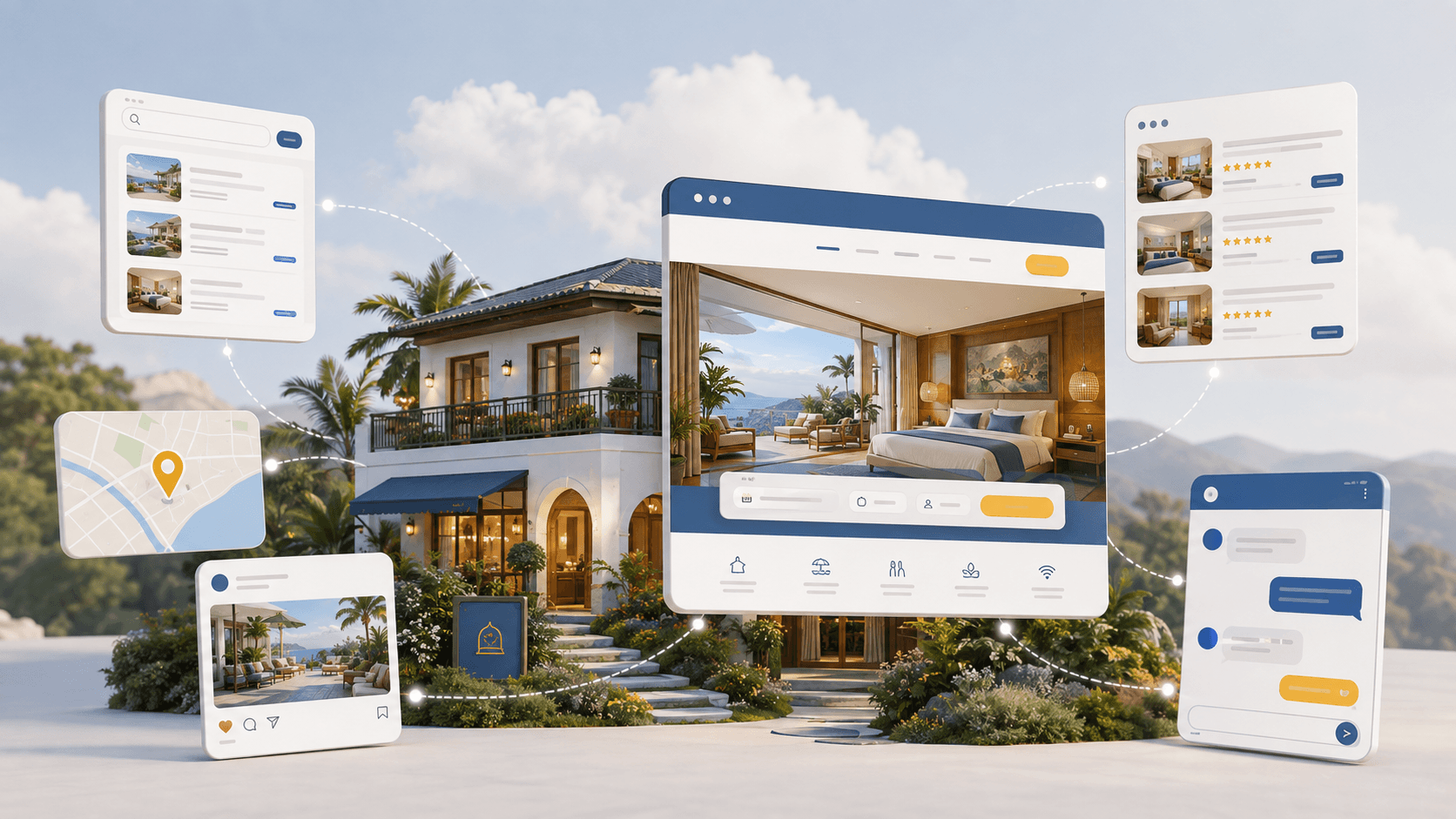
So a website doesn't need to replace Google Maps, Facebook or the OTAs. Instead, it can serve as a central destination where guests come to learn more after they've found you through those channels.
2. Facebook and Instagram build interest, but they weren't designed to be hotel websites
Social media is great for storytelling: sunset photos, breakfast moments, guest reviews, festival promotions, or a short clip of a newly renovated room.
But guests also want the basics:
- What room types do you have?
- What are your starting rates?
- How many guests does each room sleep?
- Is there parking?
- What time is check-in?
- Where exactly are you?
- How do I reach you on LINE?
If that information is scattered across months of posts, guests have to go digging for it.
A website organizes the essentials into clear sections, for example Home → Rooms → Facilities → Map → Contact, so guests don't have to scroll back through old posts to understand your property.
Social media captures attention; a website helps guests understand and decide. The two work best together.
3. OTAs help you sell rooms, but a website gives your brand its own space
Agoda, Booking.com and other booking platforms are valuable because they put your property in front of people who are actively looking for a room.
However, your OTA listing has to follow that platform's format: the photos, the order of information, the button placement and the overall presentation. Much of it isn't fully in your control.
A website is different, because you decide what guests see first.
If your property is known for its mountain views, that view can be the hero image on your homepage. If your selling point is a family-friendly pool, you can tell that story clearly. If you run a small hostel with a distinctive personality, your website can reflect it through colors, fonts, photos and copy.
A website isn't just a place to store information. It's where people come to understand why they should stay with you.
4. A website makes it easier for guests to contact you directly
A hotel website doesn't need a booking engine on day one. For a small property, a simple website can do a simple job, such as:
View rooms → Check rates → Tap LINE → Ask about availability
or
Read the details → Tap to call → Contact the hotel
That alone moves a guest from "just browsing" to "getting in touch." Later, as your business grows, you can consider adding a booking system, online payments or a booking engine.
The key point: don't let the idea that a website needs a big system stop you from starting at all.
For a small hotel, a website that is simple, loads quickly, works well on mobile, and clearly leads guests to a contact channel may be all you need at the start.
5. A website helps you get found for searches beyond your hotel's name
This is the part many properties overlook.
Say your property is called Baan Lom Nuea. People who already know you might search for:
Baan Lom Nuea Chiang Mai
But many new guests don't know your name yet. They might search for:
Chiang Mai hotel close to nature
or
family hotel in Chiang Mai
or
Chiang Mai accommodation with parking
or even a place to stay near a particular attraction.
If your website has pages that clearly explain these details, along with content that answers what travelers are searching for, search engines have more to work with when figuring out what your property is relevant to.
Google recommends creating content that is genuinely helpful to users and placing the words people would use to search for that content in prominent spots, such as the page title and headings. That's why a website and SEO can become a long-term channel for an accommodation business.
6. Some guests search your hotel's name on Google before they decide
Here's a very common scenario: a guest sees your hotel on Facebook, or a friend sends them a link, and they type your hotel's name into Google.
At that moment, whatever appears in the search results becomes part of your credibility.
Google Maps may show your location and reviews, OTAs may show prices, and Facebook may show your social content. Your own website can be the source of information straight from your brand, bringing together:
- An overview of the property
- Room types
- Rates
- Facilities
- Highlights
- Location
- Frequently asked questions
- Contact channels
For a guest who is on the fence, clear information can be the small detail that makes the decision easier.
If you already have Google Maps, do you still need a website?
Google Maps matters a lot, and every property should keep it in good shape, especially the basics: business name, location, phone number, photos, reviews and accommodation details.
Google says properties can create and verify a Business Profile so the business appears on Google Search and Maps. But Google Maps and a website do different jobs.
Google Maps helps people discover and verify you. Your website helps people get to know you and decide.
So you don't have to choose between them. The better approach is to connect the two, for example:
Google Search → Google Maps → Website → View rooms → Contact on LINE
Which hotels don't need to rush into a website?
A website is useful, but that doesn't mean every business has to invest right away. You may not need to hurry if:
- You've just opened as a trial and aren't sure what form the business will take
- Your information, room types, rates or positioning are still changing all the time
- You don't have photos or basic information ready to present yet
- Nearly all your guests come from a specific channel that already meets your needs
- No one is available to maintain even the basic information on your online channels
In these cases, getting your Google Business Profile, social media, photos and property details in order first may matter more.
Build a website when it will genuinely help your business, not just because "other hotels have one."
7 signs your property is ready for a website
See how many of these apply to you.
1. Guests keep asking the same questions
"What room types do you have?" "How much is it?" "Is there parking?" "Do you allow pets?" A website can answer these basics before guests even message you.
2. Your information is spread across many channels
Rates are on LINE, photos are on Facebook, the map is on Google and room details are on Agoda. It may be time for one central page that brings it all together.
3. You want more people to find you on Google
Especially people who aren't typing your hotel's name.
4. You want to build your own brand
And you don't want the guest experience to begin and end on an OTA listing page.
5. You want to make it easy for guests to contact you directly
A website can place LINE, phone, Facebook or booking buttons where guests can't miss them.
6. Guests ask for your hotel's website
Particularly companies, seminar groups, international travelers, or anyone who wants more information before deciding.
7. Your business is growing and you want a long-term online setup
Today it might be an information website; later you might add booking, promotions, multiple languages or back-office tools. Starting with the right structure makes it easier to build on in the future.
What should a small hotel website include?
You don't need 20 pages. For a small property, these sections may be all that really matters.
Homepage
Help visitors understand quickly what this place is, who it's for, and what makes it worth a look.
Rooms
Photos, room types, maximum occupancy and starting rates should be easy to find.
Facilities
Wi-Fi, parking, breakfast, a swimming pool, and any other services.
About
Tell the story and share what sets your property apart from the alternatives.
Location and map
Include directions and nearby places of interest.
FAQ
Cover check-in and check-out times, child policy, pets, extra beds, parking, and anything else guests often ask.
Contact or book
Make the call, LINE or booking buttons easy to see, especially on mobile.
A small website with complete information that's easy to use is more valuable than a large one where guests can't find what they need.
So, does a small hotel need a website?
If the question is "Can I run a hotel without a website?", the answer is yes, of course. Plenty of properties start out with Facebook, Google Maps and OTAs.
But if the question becomes "If I want to build my own brand, make information easier to find, have a chance of being discovered on Google, and create a contact channel my business owns, is a website useful?", the answer is yes.
A website doesn't need to replace Agoda, Facebook or Google Maps. It can be the hub that connects them all.
Social media makes people aware of you, Google helps them discover you, OTAs help them compare and book, and your website helps them get to know your property the way you want to present it.
For a small hotel, getting started doesn't have to be complicated. On day one, a good website may need to do just one thing: make it easier for people interested in your property to take the next step.
Wondering what kind of website your property needs?
PAAK IN designs websites for hotels, resorts, hostels and other accommodation businesses. You can start with a simple website that fits the size of your business, then add more features when you need them.
If you already have Facebook, LINE, Google Maps or OTA listings but aren't sure how to connect all those channels, take a look at PAAK IN's website examples and packages to find the right approach for your property.